On a completely unrelated note, I want to take a moment to address any people who have stumbled across this blog in search of advice or firsthand experience regarding ESL in Korea. When I first began researching, the majority of good advice I found was located on blogs just like this one, and I am indebted to them for providing an extremely helpful and accurate picture of what I would be getting into. Furthermore, there is depth to the information on someone's year-long blog that you won't find on any recruiting website, and a refreshing lack of the bitterness and venom that you will find on Dave's ESL Cafe.
So, if there are any such readers, please don't be afraid to ask any questions you might have about what you will be getting yourself into. This is especially true if you live in the New York area, as I can give you a step by step on the documents process as well. I could always use fodder for new posts, but most of all I just want to be able to provide the same help that I garnered a few months ago.
Friday, October 26, 2012

Damn Hitler...Always Ruining Everything
This post is meant as a response and a brief history lesson. There were a few (only a few, thankfully) people who were shocked or at least given pause when I put this picture up on Facebook last month:

"Why Connor," they said, "what ever were you doing hiking up to a Nazi shrine?" For the uninitiated, the Swastika is actually a millenia-old symbol of Hindu religion. Buddhism, as an outgrowth of Hinduism, adopted the symbol long ago and it is positively everywhere in Korea that has any Buddhist connections. Every temple I have visited has been decorated with several. The Nazi Party adopted the symbol in the early 20th century, and Hitler made it the centerpiece of his Nazi flag. You will notice, though, that he flipped the symbol -- those that you see here will look slightly different because they are facing clockwise, rather than counterclockwise as Westerners are used to seeing.
It is funny the power that even a simple symbol can have on human beings. I like to think of myself as a pretty open-minded person, and the swastikas painted onto the side of temples here look like a perfectly natural part of the architecture to me, as they should. However, with only the color and direction reversed, it is hard not to experience the typical knee-jerk reaction when you see this flag flapping in the wind:
 It can hardly be called subliminal, because surely we're all aware of it,
but the ability of something as innocuous as two geometric lines to pervade one's consciousness is quite strange.
It can hardly be called subliminal, because surely we're all aware of it,
but the ability of something as innocuous as two geometric lines to pervade one's consciousness is quite strange.

"Why Connor," they said, "what ever were you doing hiking up to a Nazi shrine?" For the uninitiated, the Swastika is actually a millenia-old symbol of Hindu religion. Buddhism, as an outgrowth of Hinduism, adopted the symbol long ago and it is positively everywhere in Korea that has any Buddhist connections. Every temple I have visited has been decorated with several. The Nazi Party adopted the symbol in the early 20th century, and Hitler made it the centerpiece of his Nazi flag. You will notice, though, that he flipped the symbol -- those that you see here will look slightly different because they are facing clockwise, rather than counterclockwise as Westerners are used to seeing.
It is funny the power that even a simple symbol can have on human beings. I like to think of myself as a pretty open-minded person, and the swastikas painted onto the side of temples here look like a perfectly natural part of the architecture to me, as they should. However, with only the color and direction reversed, it is hard not to experience the typical knee-jerk reaction when you see this flag flapping in the wind:

Wednesday, October 24, 2012
Gaysan National Park and Haeinsa Temple
Sorry for the long absence from blogging, loyal readers! Last week was fairly busy, but I hope I can get back on schedule this week.
As is demanded by the nature gods in the fall season, I went camping yet again last weekend. I am well on my way to checking every Korean National Park off my list. This time, it was Gayasan National Park. As with most of the parks in Korea, the terrain is pretty rugged, but that is hardly enough to keep away the mobs of tourists. I got a slightly different taste of camping this time, as opposed to the shelters of Jirisan, because there are only campgrounds for tents in Gayasan. Again, these are not the typical campgrounds that I'm used to. Every one of them has road access, running water, and bathrooms, and associated fees. Just past the bus stop in the charming mountain village of Chi-in (about a 1.5 hour ride from Daegu), there are three campgrounds to choose from. I was shocked to see only 6 tents set up in the first (which can allegedly accommodate 100), especially during fall, which is clearly the best time to go backpacking. The second campground, situated next to a small brook, was completely deserted. The bathrooms were locked, and the running water was off. I walked up and down the road for 30 minutes looking for an office, or a park official, or any place where I could pay my fee or find out if this particular site was closed. I couldn't find any, so I got the whole site to myself and didn't have to pay a dime. Upon leaving, I saw a sign and copied down the characters for later translation. It said, upon review, "Campsite closed because of wind." Oh well, one more advantage to being the ignorant foreigner!

Luke, Tom, Lisa, and Lisa, other teachers from Avalon, met me at the bus stop the following morning to hike the Gayasan Peak and check out Haeinsa Temple, which is on the way. Haeinsa was one of the bigger temple complexes I've yet visited, and the decorations went above and beyond what one usually sees at these sites, although there is one thing that still throws me, as a Westerner.

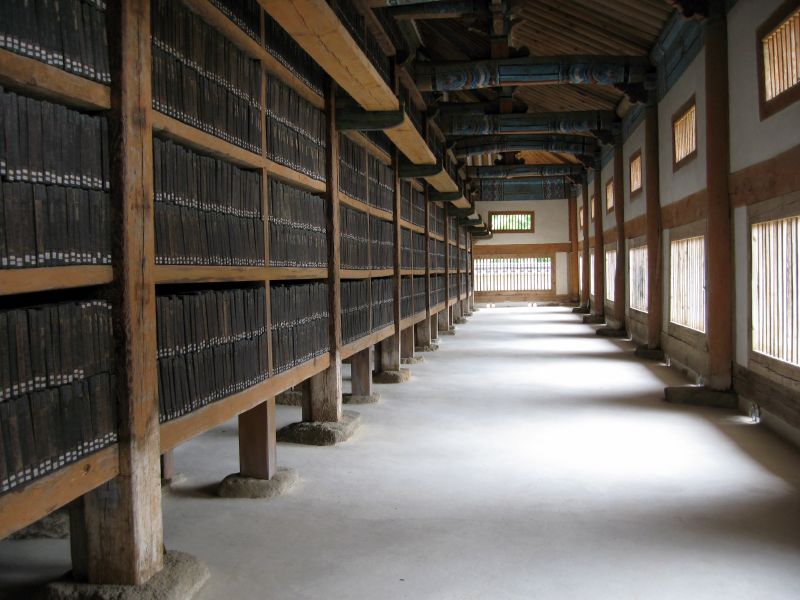
Haeinsa was by far the most crowded temple I've been to yet, and though the architecture was more of the same, Haeinsa is special for a few other reasons. First of all, the scenery is amazing. Like Daewonsa in Jirisan, the buildings are nestled perfectly among the mountains of Gayasan. Second, Haeinsa is home to the Tripitaka Koreana, which are a set of 81,258 wooden blocks from the 13th century containing the Buddhist scriptures in Hanja (Chinese characters). They are only viewable through wooden slats on the outside of the buildings and photography is forbidden, so here's an image courtesy of Wikipedia:
 Finally, as this collection of ancient wooden texts attests, Haeinsa is one of the few major temples that survived the Japanese occupation. It has undergone numerous renovations since its construction in 802 AD, and was almost completely burned in the 19th century, but it still holds the place of oldest temple I have seen yet.
After we spent a while at the temple and got involved in a photo-op with an extremely touchy ajumma (that's a middle-aged Korean woman) who was very fond of foreigners, we started up the trail. It quickly became apparent how lucky we were over the Chuseok holiday as far as crowds, because the mountain was absolutely packed. I started to count the number of other hikers I passed, but got depressed and gave up after I reached 200 (and that was before I even reached the summit). Not since Peru have I had to share the heights of the great outdoors with so many people. Here is the seemingly endless line waiting for the summit:
 And here is the zoo that is the summit of Sangwangbong itself:
 You can see at the very top of the photo another huge line of people waiting to make the twin summit of Chilbulbong. In spite of the endless crowds, we triumphed! And the whole hike was one long stroll through foliage whose like I haven't seen since I left the Adirondacks (it still didn't compare though).


Luke and I came down the opposite side of the mountain, which was luckily a little less crowded, though we still had to pass crowds of other hikers on the narrow trail frequently. All told, it was about 2.5 miles from Haeinsa to the summit of Gayasan, a 2 hour hike at a fast clip. The hike down to Baengundong Village, another 3 miles, took just about 1.5 hours.
Baengundong seemed to be a much more popular destination with tourists than Chi-in, where the bus from Daegu deposited me. There were flocks of taxis and tour buses positively everywhere at the eastern foot of the mountain range. They were all Korean weekender tourists, with the exception of one. Living here, you quickly get used to people approaching you and chattering away in a language that you don't understand one bit, so you learn to ignore it, or at the very least smile and nod. In the main parking lot, a Korean woman approached us, obviously looking to ask us a question or garner help of some sort. A park official stepped in and politely rattled off her spiel in Korean, but the woman was just as perplexed as we were. Turns out she was from Hawaii, and spoke even less Korean than us, so she finally had someone to ask about the hiking trails. It's funny what can throw you for a loop when you judge a book by its cover.
Gayasan is the closest national park to Daegu, so I foresee many more day or overnight visits in the future. However, one thing that is quickly becoming clear is that despite the downfalls of my schedule at EMS, there is something to be said for being able to go camping on Wednesday and Thursday. It's crowded enough in the woods here on a weekday, and the weekends are absolute pandemonium.
Most of my hiking posts seem to be rather verbose, so I'll cap it here for today. I have a lot more to talk about this week though, so stay tuned!
As is demanded by the nature gods in the fall season, I went camping yet again last weekend. I am well on my way to checking every Korean National Park off my list. This time, it was Gayasan National Park. As with most of the parks in Korea, the terrain is pretty rugged, but that is hardly enough to keep away the mobs of tourists. I got a slightly different taste of camping this time, as opposed to the shelters of Jirisan, because there are only campgrounds for tents in Gayasan. Again, these are not the typical campgrounds that I'm used to. Every one of them has road access, running water, and bathrooms, and associated fees. Just past the bus stop in the charming mountain village of Chi-in (about a 1.5 hour ride from Daegu), there are three campgrounds to choose from. I was shocked to see only 6 tents set up in the first (which can allegedly accommodate 100), especially during fall, which is clearly the best time to go backpacking. The second campground, situated next to a small brook, was completely deserted. The bathrooms were locked, and the running water was off. I walked up and down the road for 30 minutes looking for an office, or a park official, or any place where I could pay my fee or find out if this particular site was closed. I couldn't find any, so I got the whole site to myself and didn't have to pay a dime. Upon leaving, I saw a sign and copied down the characters for later translation. It said, upon review, "Campsite closed because of wind." Oh well, one more advantage to being the ignorant foreigner!

Luke, Tom, Lisa, and Lisa, other teachers from Avalon, met me at the bus stop the following morning to hike the Gayasan Peak and check out Haeinsa Temple, which is on the way. Haeinsa was one of the bigger temple complexes I've yet visited, and the decorations went above and beyond what one usually sees at these sites, although there is one thing that still throws me, as a Westerner.

Haeinsa was by far the most crowded temple I've been to yet, and though the architecture was more of the same, Haeinsa is special for a few other reasons. First of all, the scenery is amazing. Like Daewonsa in Jirisan, the buildings are nestled perfectly among the mountains of Gayasan. Second, Haeinsa is home to the Tripitaka Koreana, which are a set of 81,258 wooden blocks from the 13th century containing the Buddhist scriptures in Hanja (Chinese characters). They are only viewable through wooden slats on the outside of the buildings and photography is forbidden, so here's an image courtesy of Wikipedia:
After we spent a while at the temple and got involved in a photo-op with an extremely touchy ajumma (that's a middle-aged Korean woman) who was very fond of foreigners, we started up the trail. It quickly became apparent how lucky we were over the Chuseok holiday as far as crowds, because the mountain was absolutely packed. I started to count the number of other hikers I passed, but got depressed and gave up after I reached 200 (and that was before I even reached the summit). Not since Peru have I had to share the heights of the great outdoors with so many people. Here is the seemingly endless line waiting for the summit:


Luke and I came down the opposite side of the mountain, which was luckily a little less crowded, though we still had to pass crowds of other hikers on the narrow trail frequently. All told, it was about 2.5 miles from Haeinsa to the summit of Gayasan, a 2 hour hike at a fast clip. The hike down to Baengundong Village, another 3 miles, took just about 1.5 hours.
Baengundong seemed to be a much more popular destination with tourists than Chi-in, where the bus from Daegu deposited me. There were flocks of taxis and tour buses positively everywhere at the eastern foot of the mountain range. They were all Korean weekender tourists, with the exception of one. Living here, you quickly get used to people approaching you and chattering away in a language that you don't understand one bit, so you learn to ignore it, or at the very least smile and nod. In the main parking lot, a Korean woman approached us, obviously looking to ask us a question or garner help of some sort. A park official stepped in and politely rattled off her spiel in Korean, but the woman was just as perplexed as we were. Turns out she was from Hawaii, and spoke even less Korean than us, so she finally had someone to ask about the hiking trails. It's funny what can throw you for a loop when you judge a book by its cover.
Gayasan is the closest national park to Daegu, so I foresee many more day or overnight visits in the future. However, one thing that is quickly becoming clear is that despite the downfalls of my schedule at EMS, there is something to be said for being able to go camping on Wednesday and Thursday. It's crowded enough in the woods here on a weekday, and the weekends are absolute pandemonium.
Most of my hiking posts seem to be rather verbose, so I'll cap it here for today. I have a lot more to talk about this week though, so stay tuned!
Sunday, October 14, 2012
Jinju Lantern Festival
Yesterday some of the other Avalon teachers and I went to Jinju again, but this time to see more of the city than just the bus terminal. All week long was Jinju's annual Lantern Festival; we caught it on what I think was the last day. Here are some highlights:


 The best ones by far were the signs of the Chinese zodiac. The Rabbit looked particularly pretentious and pleased with himself, as us rabbits usually are. "Ah yes, 1987," he is saying, "it was a good year..."


Again, it was weird going to an event like this in a foreign country, because I couldn't shake the nagging feeling of sameness that has been following me since I got here. The Festival was a large section of the city cordoned off and full of families, tourists, Disney characters, a near fatal amount of kitsch, and weird snacks on sticks. In short, it was a festival, much like any other festival. At the end of the night, Matty and I sat on the plaza steps, eating pizza, and watching with their faces buried in their phones trip over the first step. That'll learn them to pay attention to the world around them. All in all, it was a good day.
In other news, after the windfall of my first paycheck, I did what any sane person would do and I bought a Kia!

 Yes, that is a 5-speed Kia Soul. I didn't know they made bikes either, but at least I finally have my natural form of transportation back!
Again, it was weird going to an event like this in a foreign country, because I couldn't shake the nagging feeling of sameness that has been following me since I got here. The Festival was a large section of the city cordoned off and full of families, tourists, Disney characters, a near fatal amount of kitsch, and weird snacks on sticks. In short, it was a festival, much like any other festival. At the end of the night, Matty and I sat on the plaza steps, eating pizza, and watching with their faces buried in their phones trip over the first step. That'll learn them to pay attention to the world around them. All in all, it was a good day.
In other news, after the windfall of my first paycheck, I did what any sane person would do and I bought a Kia!
Friday, October 12, 2012
You Sure Got a Lot of Cranium Accesories!
Last month, Dennis asked me what the strangest thing about Korea is. I still am not sure how to answer that question. There are a lot of strange things going on over here in the Hermit Kingdom, but what is the weirdest? Perhaps it is the physical affection between boys (they hold hands, play with each other's hair in class, and engage in other behavior which wouldn't necessarily make an American feel uncomfortable, but would surely make them look askance). Perhaps it's the fact that every sign -- whether corporate or official -- has to reach a certain threshold of cuteness (Tom has said that he doesn't trust any smiling Korean cartoons with heads bigger than their bodies...there are a lot of untrustworthy mascots here then).
However, I can tell you what I think the stupidest thing about Korea is. As silly as I think it is every time I see the spectacle of people walking down the street screaming into their Bluetooth headset, it can't compare to this:


However, I can tell you what I think the stupidest thing about Korea is. As silly as I think it is every time I see the spectacle of people walking down the street screaming into their Bluetooth headset, it can't compare to this:

(I didn't take the picture, only found it on Google.
It is, however, something I see at least eight times a day.)
Yes, that is the Samsung Galaxy Tab, Korea's answer to the iPad. People use their Galaxy Tabs here to do everything -- including taking phone calls! Imagine trying to have a conversation with an iPad on your head. Even better, imagine trying to have a conversation with a book on your head, because that's what you look like every time you commit this technological faux pas.
Did the '80s come back without me noticing?

Tuesday, October 9, 2012
A Whole New World of Advertisement
Here's how I imagine the interview for a Korean commercial actor goes:
Recruiter: Well, your qualifications look pretty good. Do you have any acting experience?
Applicant: No.
Recruiter: Well, can you look shocked at a bottle of fabric softener?
Applicant: I certainly can.
Recruiter: Can you be flabbergasted by a bowl of Ramen?
Applicant: Definitely.
Recruiter: Can you yell at household cleaning supplies?
Applicant: Are you kidding? I do that in my spare time!
Recruiter: Great, you're hired!
Recruiter: Well, your qualifications look pretty good. Do you have any acting experience?
Applicant: No.
Recruiter: Well, can you look shocked at a bottle of fabric softener?
Applicant: I certainly can.
Recruiter: Can you be flabbergasted by a bowl of Ramen?
Applicant: Definitely.
Recruiter: Can you yell at household cleaning supplies?
Applicant: Are you kidding? I do that in my spare time!
Recruiter: Great, you're hired!
Saturday, October 6, 2012
Daewonsa (Chuseok Part 2)
On our way out of Jirisan, we stopped by Daewonsa, a Buddhist temple right on the edge of the park. With the exception of Bangnyeonsa, in the foothills behind my apartment building, this was the least crowded temple I had seen since arriving here. This may have been due to the fact that it was a holiday, but it was peaceful and quiet, and had the added advantage of being much larger and more beautiful than Bangnyeonsa. Also, despite the gift shop and parking lot, Daewonsa seemed to me to have a much more traditional feel than the other temples I've visited. Perhaps there is a smaller portion of modern technology and comforts there. I like to think though, that the keepers of Daewonsa have simply done a better job of seamlessly integrating nature, tradition, and modernity.
Here is a photo just begging to be turned into an advertisement for Osprey Packs:

And a few more:


One of the temple buildings was also undergoing renovations, and visitors are able to help finance it. For a small donation, you are allowed to write your name and your wish or philosophy or motto on one of the tiles which will be used on new roof. Of course we had to make our marks. A Korean family was taking advantage of the incentive as well, and made us feel very inept and unsatisfied with our penmanship. The father's writing was so beautifully calligraphic and symmetrical, meanwhile we were struggling not to bleed the letters together and to get an entire sentence to fit on the tile. We blamed it on the broad-tipped markers, but perhaps Buddhist prayers just aren't meant to be written in the Roman alphabet. Here is our handiwork:

In the meantime, I can enjoy the temples for what they are: often beautiful and blissfully quiet (relatively speaking of course) retreats.
Subscribe to:
Posts (Atom)