Sorry for the long absence from blogging, loyal readers! Last week was fairly busy, but I hope I can get back on schedule this week.
As is demanded by the nature gods in the fall season, I went camping yet again last weekend. I am well on my way to checking every Korean National Park off my list. This time, it was Gayasan National Park. As with most of the parks in Korea, the terrain is pretty rugged, but that is hardly enough to keep away the mobs of tourists. I got a slightly different taste of camping this time, as opposed to the shelters of Jirisan, because there are only campgrounds for tents in Gayasan. Again, these are not the typical campgrounds that I'm used to. Every one of them has road access, running water, and bathrooms, and associated fees. Just past the bus stop in the charming mountain village of Chi-in (about a 1.5 hour ride from Daegu), there are three campgrounds to choose from. I was shocked to see only 6 tents set up in the first (which can allegedly accommodate 100), especially during fall, which is clearly the best time to go backpacking. The second campground, situated next to a small brook, was completely deserted. The bathrooms were locked, and the running water was off. I walked up and down the road for 30 minutes looking for an office, or a park official, or any place where I could pay my fee or find out if this particular site was closed. I couldn't find any, so I got the whole site to myself and didn't have to pay a dime. Upon leaving, I saw a sign and copied down the characters for later translation. It said, upon review, "Campsite closed because of wind." Oh well, one more advantage to being the ignorant foreigner!
Luke, Tom, Lisa, and Lisa, other teachers from Avalon, met me at the bus stop the following morning to hike the Gayasan Peak and check out Haeinsa Temple, which is on the way. Haeinsa was one of the bigger temple complexes I've yet visited, and the decorations went above and beyond what one usually sees at these sites, although there is one thing that still throws me, as a Westerner.
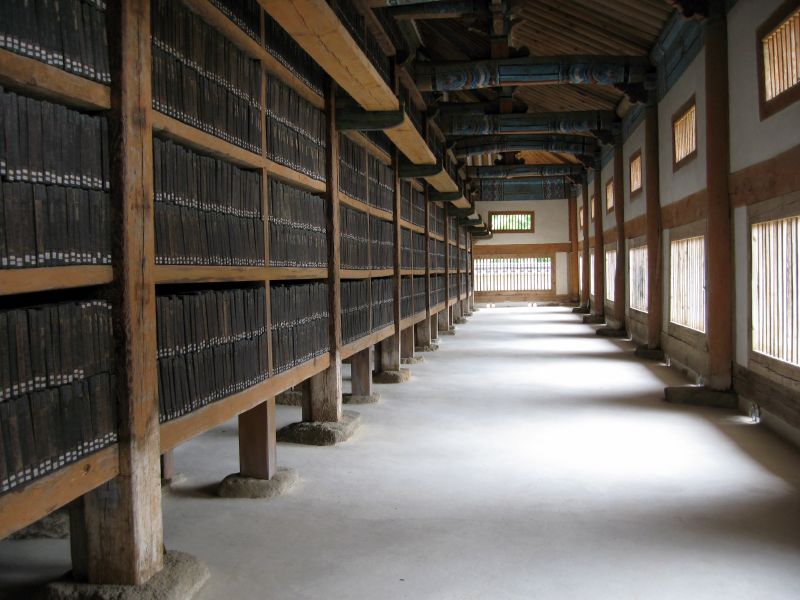
Haeinsa was by far the most crowded temple I've been to yet, and though the architecture was more of the same, Haeinsa is special for a few other reasons. First of all, the scenery is amazing. Like Daewonsa in Jirisan, the buildings are nestled perfectly among the mountains of Gayasan. Second, Haeinsa is home to the Tripitaka Koreana, which are a set of 81,258 wooden blocks from the 13th century containing the Buddhist scriptures in Hanja (Chinese characters). They are only viewable through wooden slats on the outside of the buildings and photography is forbidden, so here's an image courtesy of Wikipedia:
Finally, as this collection of ancient wooden texts attests, Haeinsa is one of the few major temples that survived the Japanese occupation. It has undergone numerous renovations since its construction in 802 AD, and was almost completely burned in the 19th century, but it still holds the place of oldest temple I have seen yet.
After we spent a while at the temple and got involved in a photo-op with an extremely touchy ajumma (that's a middle-aged Korean woman) who was very fond of foreigners, we started up the trail. It quickly became apparent how lucky we were over the Chuseok holiday as far as crowds, because the mountain was absolutely packed. I started to count the number of other hikers I passed, but got depressed and gave up after I reached 200 (and that was before I even reached the summit). Not since Peru have I had to share the heights of the great outdoors with so many people. Here is the seemingly endless line waiting for the summit:
And here is the zoo that is the summit of Sangwangbong itself:
You can see at the very top of the photo another huge line of people waiting to make the twin summit of Chilbulbong. In spite of the endless crowds, we triumphed! And the whole hike was one long stroll through foliage whose like I haven't seen since I left the Adirondacks (it still didn't compare though).
Luke and I came down the opposite side of the mountain, which was luckily a little less crowded, though we still had to pass crowds of other hikers on the narrow trail frequently. All told, it was about 2.5 miles from Haeinsa to the summit of Gayasan, a 2 hour hike at a fast clip. The hike down to Baengundong Village, another 3 miles, took just about 1.5 hours.
Baengundong seemed to be a much more popular destination with tourists than Chi-in, where the bus from Daegu deposited me. There were flocks of taxis and tour buses positively everywhere at the eastern foot of the mountain range. They were all Korean weekender tourists, with the exception of one. Living here, you quickly get used to people approaching you and chattering away in a language that you don't understand one bit, so you learn to ignore it, or at the very least smile and nod. In the main parking lot, a Korean woman approached us, obviously looking to ask us a question or garner help of some sort. A park official stepped in and politely rattled off her spiel in Korean, but the woman was just as perplexed as we were. Turns out she was from Hawaii, and spoke even less Korean than us, so she finally had someone to ask about the hiking trails. It's funny what can throw you for a loop when you judge a book by its cover.
Gayasan is the closest national park to Daegu, so I foresee many more day or overnight visits in the future. However, one thing that is quickly becoming clear is that despite the downfalls of my schedule at EMS, there is something to be said for being able to go camping on Wednesday and Thursday. It's crowded enough in the woods here on a weekday, and the weekends are absolute pandemonium.
Most of my hiking posts seem to be rather verbose, so I'll cap it here for today. I have a lot more to talk about this week though, so stay tuned!
Showing posts with label Hiking. Show all posts
Wednesday, October 24, 2012
Thursday, October 4, 2012
Hiking in Korea (Chuseok Part 1)
The first part of my Chuseok vacation was of course a trip to the mountain fastnesses of my new home. I've done a bit of day hiking around Daegu since I arrived, but this was to be my first overnight trip, and it had been far too long since I spent a night in the woods. So along with Tom and Lisa (two other teachers from Avalon) and Tahirih (a friend from Potsdam who is also teaching in Korea), I packed up my trusty Atmos 65 and headed off to Jirisan National Park.
Jirisan (also the name of the primary mountain in the Park) is Korea's oldest national park and home to Cheonwangbong, the highest peak in mainland Korea, at 6,283 feet. Jirisan is one of the country's most popular hiking destinations, and the 182 square mile park gets almost 300,000 visitors every year. That's 1,648 visitors for every square mile. Compare this to the Adirondack Park, which, though it gets an average of 8 million visitors a year, equals out to only 835 people per square mile. Needless to say, the first thing to go out the window when hiking in Korea is any illusion that you might be able to appreciate some solitude in the woods. As such, Chuseok (the Korean Thanksgiving) seemed like a perfect time to visit Jirisan. On Chuseok, nearly the entire country is busy visiting and feasting with relatives, so it is allegedly one of the only times you will be able to hike through the mountains without having to wait in line on the trails.
At the crack of dawn on Saturday, we took an express bus to the city of Jinju. The timetables and transfer points were a bit daunting, but it turns out that the bus system is not too difficult to navigate. In Jinju, there are buses running every hour (sometimes more frequently) to every one of the trailheads in Jirisan, of which there are almost a dozen. This is a major point for Korea. The public transportation system here is not only astoundingly efficient, cheap, and extensive, but it also seems that the accessibility of the wilderness is near mandatory.
Where I take points off is the lack of any semblance of true wilderness, and the crippling regulations. In Korean parks -- both provincial and national -- camping is only allowed at designated campsites (which are always immediately adjacent to parking lots and made to accommodate hundreds of people) or "shelters" within the park. These "shelters" are not shelters as I know them. Instead they are enormous buildings (thousands of feet up and miles into the woods, mind you) with floor heating, blankets for rent, a cooler full of drinks, Ramen for sale, toilets, urinals, a cordoned-off smoking section, cell phone chargers, and of course a 3G signal. You pay ₩ 7,000 (roughly $6.50) to share a cramped living space with anywhere from 12 to 100 other snoring people. The berths are no more than 2 feet wide, and women and men are forbidden from sleeping in the same rooms. The sounds of birds and bugs are virtually non-existent. Instead you hear K-Pop and loud, lengthy cell-phone conversations at your campsite.
If you'll pardon the temporary mounting of my high horse, I will say it's hard to get the camping experience that I'm used to in this environment. Where I come from, this is a shelter:
This is what I'd call a house:
It's also hard to get back to nature, as it were, when helicopter rescue is only a QR code away:
As far as the regulations, of course you aren't allowed to camp anywhere except the shelters, so it is unfortunately a choice between sharing your lodging with 50 snoring Koreans, or not staying in the park overnight. Fires are forbidden anywhere except the shelters. That includes stove fires, so you can forget about a hot victory lunch on the summit. You are also forbidden from hiking at night. Hiking hours are from two hours before sunrise to two hours after sunset. We chose to ignore this particular rule, in pursuit of a sunrise from Cheonwangbong. We got fogged out of the sunrise, but did get some spectacularly clear night hiking in anyway:
The downsides of the "shelters" notwithstanding, the park has absolutely beautiful scenery. The trails are a healthy mix of wooden and metal steps, roped up rock scrambles, and the the intense, vertical, scoff-at-even-the-idea-of-switchbacks type of terrain that I have come to know and love hiking in the Northeast U.S.
The views, thanks to the gorgeous fall weather, were stunning.
And here we are at the highest point in the Korean mainland:
I ended up revising the route several times before entering the park, after realizing, as I usually do, that I was far too ambitious at first. It was a good thing too, because the terrain was just as tough as any I've hiked. Our first day was 3.7 miles in to Saeseok Shelter, which took a lazy 5 or 6 hours. Our second day was 5.6 miles and five peaks in the course of 10 hours (with a long nap and breakfast in between). The third day was 4.2 miles, all downhill (and thankfully we picked the right way to go down, it would have been a nightmare in the other direction!). Our second night was spent at a much smaller, much less crowded, and much nicer shelter. The shelter had an amazing view, a considerably nicer manager, and a dog for a mascot. Overall, it was a much better experience the second night (though I still would have preferred to set up my tent or hammock somewhere else).
On Monday, we spent a lazy morning enjoying the sunrise from the picnic tables, and a nice Korean couple struck up a conversation with us. Koreans, as a rule, don't have the same hang-ups as we Americans do about friendly and even intimate conversations with strangers. We were offered food -- Korean barbecue with fresh meat and vegetables -- by no less than four other groups of hikers, and accepted graciously though we had nothing but paltry trail mix and oatmeal with which to reciprocate. This particular couple was excited to practice their English and advertise their camping shop on Goeje Island (which I will certainly have to make a point to visit).
All in all, Jirisan was an outstanding experience. The terrain was similar enough that I was right at home hiking it, but the scenery was sufficiently Asian, as I thought it. I imagined martial arts masters training under waterfalls that we passed and The Monkey King capering around on promontories not unlike the ones I was seeing. Fall, as we all know, is the best season to go hiking, and it is no different in Korea. The woods are beautiful, the temperature is perfect, the bugs are absent, and the trails are a bit less crowded.
I feel compelled to make a comparison between the hobby I love in The States and the one that has fast become the national pastime of Korea. Being an entirely mountainous country with a booming economy and middle class, the accessibility of hiking trails and parks is top notch. The public transportation system encourages both urban and rural people to take advantage of the outdoors, and the Koreans' enterprising and friendly nature make them excellent hikers and gear salespeople. However, a lot of what makes backpacking special for me seems not to exist here. There is little solitude, and none of the self-imposed exile from the trappings of civilization that gives me a new perspective on myself and the company I keep in the woods. It is not surprising that the parks have to be regulated in this way. In such a small, crowded country, I suppose my prejudices about space and wilderness from one of the largest nations on earth don't quite belong.
In any event, I am thrilled that Koreans have taken to the activity of hiking with the same enthusiasm that I have. Prepare to see many more picture-laden posts of my outdoor adventures.
Jirisan (also the name of the primary mountain in the Park) is Korea's oldest national park and home to Cheonwangbong, the highest peak in mainland Korea, at 6,283 feet. Jirisan is one of the country's most popular hiking destinations, and the 182 square mile park gets almost 300,000 visitors every year. That's 1,648 visitors for every square mile. Compare this to the Adirondack Park, which, though it gets an average of 8 million visitors a year, equals out to only 835 people per square mile. Needless to say, the first thing to go out the window when hiking in Korea is any illusion that you might be able to appreciate some solitude in the woods. As such, Chuseok (the Korean Thanksgiving) seemed like a perfect time to visit Jirisan. On Chuseok, nearly the entire country is busy visiting and feasting with relatives, so it is allegedly one of the only times you will be able to hike through the mountains without having to wait in line on the trails.
At the crack of dawn on Saturday, we took an express bus to the city of Jinju. The timetables and transfer points were a bit daunting, but it turns out that the bus system is not too difficult to navigate. In Jinju, there are buses running every hour (sometimes more frequently) to every one of the trailheads in Jirisan, of which there are almost a dozen. This is a major point for Korea. The public transportation system here is not only astoundingly efficient, cheap, and extensive, but it also seems that the accessibility of the wilderness is near mandatory.
Where I take points off is the lack of any semblance of true wilderness, and the crippling regulations. In Korean parks -- both provincial and national -- camping is only allowed at designated campsites (which are always immediately adjacent to parking lots and made to accommodate hundreds of people) or "shelters" within the park. These "shelters" are not shelters as I know them. Instead they are enormous buildings (thousands of feet up and miles into the woods, mind you) with floor heating, blankets for rent, a cooler full of drinks, Ramen for sale, toilets, urinals, a cordoned-off smoking section, cell phone chargers, and of course a 3G signal. You pay ₩ 7,000 (roughly $6.50) to share a cramped living space with anywhere from 12 to 100 other snoring people. The berths are no more than 2 feet wide, and women and men are forbidden from sleeping in the same rooms. The sounds of birds and bugs are virtually non-existent. Instead you hear K-Pop and loud, lengthy cell-phone conversations at your campsite.
If you'll pardon the temporary mounting of my high horse, I will say it's hard to get the camping experience that I'm used to in this environment. Where I come from, this is a shelter:
This is what I'd call a house:
It's also hard to get back to nature, as it were, when helicopter rescue is only a QR code away:
As far as the regulations, of course you aren't allowed to camp anywhere except the shelters, so it is unfortunately a choice between sharing your lodging with 50 snoring Koreans, or not staying in the park overnight. Fires are forbidden anywhere except the shelters. That includes stove fires, so you can forget about a hot victory lunch on the summit. You are also forbidden from hiking at night. Hiking hours are from two hours before sunrise to two hours after sunset. We chose to ignore this particular rule, in pursuit of a sunrise from Cheonwangbong. We got fogged out of the sunrise, but did get some spectacularly clear night hiking in anyway:
The downsides of the "shelters" notwithstanding, the park has absolutely beautiful scenery. The trails are a healthy mix of wooden and metal steps, roped up rock scrambles, and the the intense, vertical, scoff-at-even-the-idea-of-switchbacks type of terrain that I have come to know and love hiking in the Northeast U.S.
The views, thanks to the gorgeous fall weather, were stunning.
And here we are at the highest point in the Korean mainland:
I ended up revising the route several times before entering the park, after realizing, as I usually do, that I was far too ambitious at first. It was a good thing too, because the terrain was just as tough as any I've hiked. Our first day was 3.7 miles in to Saeseok Shelter, which took a lazy 5 or 6 hours. Our second day was 5.6 miles and five peaks in the course of 10 hours (with a long nap and breakfast in between). The third day was 4.2 miles, all downhill (and thankfully we picked the right way to go down, it would have been a nightmare in the other direction!). Our second night was spent at a much smaller, much less crowded, and much nicer shelter. The shelter had an amazing view, a considerably nicer manager, and a dog for a mascot. Overall, it was a much better experience the second night (though I still would have preferred to set up my tent or hammock somewhere else).
On Monday, we spent a lazy morning enjoying the sunrise from the picnic tables, and a nice Korean couple struck up a conversation with us. Koreans, as a rule, don't have the same hang-ups as we Americans do about friendly and even intimate conversations with strangers. We were offered food -- Korean barbecue with fresh meat and vegetables -- by no less than four other groups of hikers, and accepted graciously though we had nothing but paltry trail mix and oatmeal with which to reciprocate. This particular couple was excited to practice their English and advertise their camping shop on Goeje Island (which I will certainly have to make a point to visit).
All in all, Jirisan was an outstanding experience. The terrain was similar enough that I was right at home hiking it, but the scenery was sufficiently Asian, as I thought it. I imagined martial arts masters training under waterfalls that we passed and The Monkey King capering around on promontories not unlike the ones I was seeing. Fall, as we all know, is the best season to go hiking, and it is no different in Korea. The woods are beautiful, the temperature is perfect, the bugs are absent, and the trails are a bit less crowded.
I feel compelled to make a comparison between the hobby I love in The States and the one that has fast become the national pastime of Korea. Being an entirely mountainous country with a booming economy and middle class, the accessibility of hiking trails and parks is top notch. The public transportation system encourages both urban and rural people to take advantage of the outdoors, and the Koreans' enterprising and friendly nature make them excellent hikers and gear salespeople. However, a lot of what makes backpacking special for me seems not to exist here. There is little solitude, and none of the self-imposed exile from the trappings of civilization that gives me a new perspective on myself and the company I keep in the woods. It is not surprising that the parks have to be regulated in this way. In such a small, crowded country, I suppose my prejudices about space and wilderness from one of the largest nations on earth don't quite belong.
In any event, I am thrilled that Koreans have taken to the activity of hiking with the same enthusiasm that I have. Prepare to see many more picture-laden posts of my outdoor adventures.
Wednesday, September 26, 2012
Service
One particular aspect of Korean culture that I've grown rather fond of in my short time here is a thing called "service." It is, much like it sounds, an extra service by the proprietor or employee of an establishment for you, the good and loyal customer. This can range anywhere from a couple free bottles of Coke at the local barbecue place with dinner, to a free red bean donut at the bakery when you buy a coffee, to the situation I encountered earlier today.
This morning a Tom -- a fellow teacher -- and I went out to look for camping gear for Tom in preparation for our upcoming trip to Jirisan National Park. Those of you who had even a ten minute conversation with me anytime over the past two years know this is far from a chore for me, so I embraced it with my classic EMS-salesman-aplomb. Camping in Korea comes with a laundry list of regulations (I'll do a whole post on hiking and camping in Korea later), and actually one doesn't typically need as much technical gear as one would in The States. However, the essentials are still necessary, and Tom had few of them, so we went first to HomePlus -- essentially the Korean version of Wal-Mart -- and then to a smaller, sort of Mom & Pop camping store on the way home.
At HomePlus, we were treated to a variety of chintzy but cheap camping equipment. The salesman answered a few questions but didn't make too much of an effort, as we looked like we were just browsing. We moved on to the smaller shop, and the man staffing it was super helpful. I brought a cookset and a bottle of fuel up to him, and he told me the price. Surely that couldn't be right, I thought. I inquired as to whether or not my math was wrong. "No," he said. "This...20% off for you," he said, pointing to the cookset, and then, pointing to the gas, "and this...service." In other words, for free!
Was it because I was a foreigner? Who knows, but I can tell you I'll certainly go back for any more gear I'll need (and need more gear I will). After working at EMS for so long, and getting frustrated with every self-absorbed Upper West Side client who demands a discount, it is funny to be on the other side. However, I did not demand a discount, it was simply given to me. Perhaps because I'm just so handsome, who can tell?
Tom, meanwhile, was experiencing a serious case of sticker shock. The few pairs of boots in his size were quite expensive, so he left without getting anything (for now, at least). After we left and had walked probably 6 blocks down the street, the employee came rushing up on his bicycle, excitedly informing us that he could give Tom the boots for a mere $90, down from over $150. Still too much, but maybe next time. What a salesman!
This morning a Tom -- a fellow teacher -- and I went out to look for camping gear for Tom in preparation for our upcoming trip to Jirisan National Park. Those of you who had even a ten minute conversation with me anytime over the past two years know this is far from a chore for me, so I embraced it with my classic EMS-salesman-aplomb. Camping in Korea comes with a laundry list of regulations (I'll do a whole post on hiking and camping in Korea later), and actually one doesn't typically need as much technical gear as one would in The States. However, the essentials are still necessary, and Tom had few of them, so we went first to HomePlus -- essentially the Korean version of Wal-Mart -- and then to a smaller, sort of Mom & Pop camping store on the way home.
At HomePlus, we were treated to a variety of chintzy but cheap camping equipment. The salesman answered a few questions but didn't make too much of an effort, as we looked like we were just browsing. We moved on to the smaller shop, and the man staffing it was super helpful. I brought a cookset and a bottle of fuel up to him, and he told me the price. Surely that couldn't be right, I thought. I inquired as to whether or not my math was wrong. "No," he said. "This...20% off for you," he said, pointing to the cookset, and then, pointing to the gas, "and this...service." In other words, for free!
Was it because I was a foreigner? Who knows, but I can tell you I'll certainly go back for any more gear I'll need (and need more gear I will). After working at EMS for so long, and getting frustrated with every self-absorbed Upper West Side client who demands a discount, it is funny to be on the other side. However, I did not demand a discount, it was simply given to me. Perhaps because I'm just so handsome, who can tell?
Tom, meanwhile, was experiencing a serious case of sticker shock. The few pairs of boots in his size were quite expensive, so he left without getting anything (for now, at least). After we left and had walked probably 6 blocks down the street, the employee came rushing up on his bicycle, excitedly informing us that he could give Tom the boots for a mere $90, down from over $150. Still too much, but maybe next time. What a salesman!
Subscribe to:
Posts (Atom)
