Showing posts with label South Korea. Show all posts

Sunday, January 27, 2013

I Can't Believe It's Not Butter!

As any curious soul moving himself to another country might tend to do, I have been making it a point to try to learn the Korean language. In fact, I began a few months before I came, anticipating a challenge, and indeed I got one.

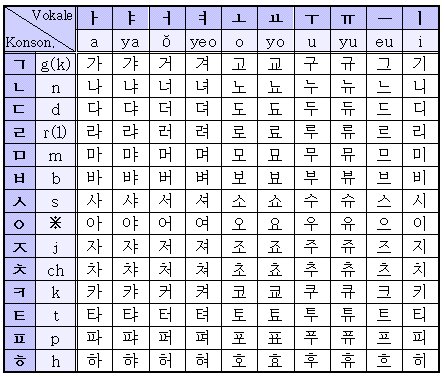
The first hurdle, of course, is dealing with another alphabet. However, Hangeul, the Korean alphabet, is actually rather user-friendly. It was developed in the 15th century at the behest of Korea's wise, benevolent, and very favorite king, Sejong. Apparently he thought that the enormous alphabet of Chinese characters (which was the current script at the time) did not suit the Korean language well, and that it was unfair to the common man, as the learning of Chinese characters was something that only upper class people with time to study and access to education could afford to do. To say that Hangeul simplified the character system is a gross understatement. Today, many of the original letters exist only in memory or collect dust in archaic words and forms, so it is even more streamlined.
 See? Easy!

Hangeul consists of 14 consonants, 5 double consonants, and 21 vowels. What an absurd number of vowels! How can the human mouth even make that many sounds?! Well, I call them vowels for easy reference, in fact Korean vowels include sounds like "ah," and sounds like "yah," and double vowels combined from two symbols, and diphthongs like "way." 

Surprisingly, with all these vowel sounds, there are still phonemes for which Korean has no single letter. For all you non-language nerds out there, a phoneme is, in layman's terms, the simplest sound you can make without changing the shape of your mouth, like "f," "sh," or "oo." It is through this discovery that I had a revelation about my own language. Some single vowels in English are in fact not phonemes, but a combination of sounds. The long I in die or the long A in ace, for example, though represented by only one letter, still require your mouth to make two separate sounds. Try it, slow down your speech and you will notice your mouth forming what you thought was one vowel with two distinct vowel sounds. So it is that in Korean, die is not one syllable, but two (이 = da-ee), and ace is not one but three (에이스 = eh-ee-suh). The third is due to the fact that the "S" sounds becomes a "T" sound on the end of a syllable, so for that reason, among many others, words often get an extra syllable. Korean is also not too fond of consonant clusters, and thus Sprite, which in English has one syllable, has five in Korean (스프라이트 = suh-puh-ra-ee-tuh). By far the most outrageous transliteration I've seen yet.

These quirks aside, the script is in fact remarkable easy to learn. It took me about two days to commit it to memory, although as always noise from one's own alphabet gets in the way when reading a new one. For example, what sound does make? Oh, well that's an E of course. Nope, that's a T. What about ㄹ? That's a 2, obviously. Wrong again, that's R/L (incidentally, one of the reasons that Koreans mix these letters up in English so much, they have no cause to differentiate the sounds in their own language). What about ㅇ? Well that has to be an O. Or at least a 0. Nope, that letter is actually silent. Or if it's feeling sly -- and aren't we all when we're at the end of a syllable -- it's NG.

Also, you face the hurdle of dealing with a syllabary. Hangeul has letters, but they don't exist on their own, only in syllables of two or three letters. So words cannot look like 
, that would of course be silly. It's written 한(Han)글(Geul). Naturally, we English speakers read and understand words one syllable at a time, but we are not used to letters stacked up on one another.

My experience with the language has been good, so far. It's not terribly difficult to pick up basic words and phrases, and once you master the alphabet and some survival vocabulary, ordering food and getting around becomes immensely easier. You might actually know what dish you're pointing at on the menu. My major problem, as someone who spent the last few years studying dead languages, is actually using it. I feel immensely confident reading and writing Korean (within the limits of my grammar and vocabulary abilities), but speaking it and listening to it (something I never had to do with Greek or Latin) are a whole other ballgame. When speaking, the problem of pronunciation of course rears its ugly head, and my feeble attempts at communication usually go over the head of the well-meaning but throughly nonplussed Koreans with whom I interact. The hardest pronunciation problem to deal with is the presence of three very similar sounding vowels, 으 (euh), 어 (uh), and 오 (oh). To use a frame of reference that only my one reader who is a Classicist will understand (Phil, I'm looking at you), this is at least ten times worse than the frustration of first coming to terms with α, ο, and ω.

The worst feeling in the world, as any learner of a foreign language knows, is the false confidence that comes with self-study. When speaking to a Korean, on a very routine basis, I find myself in a magical, miraculous sort of rhythm where all my vocabulary falls neatly into place, my grammar is flawless, and my pronunciation, though not perfect, is bordering on mediocre. I rattle off a whole paragraph and mentally pat myself on the back as I can see understanding register in my interlocutor's eyes. But then, of course, comes their thought: "well, this foreigner's Korean is actually not bad! Good for him," followed by a veritable torrent of rapid-fire foreign language way beyond my capability, and my guilty admission that I haven't understood a word of what they said. Dealing with a living language is a humbling experience, although I get oohs and aahs from my students anytime I tell them that their jacket is blue, so I guess that's something.

One of the most interesting benefits of learning Korean is gaining insight into Korean culture using nothing but language and grammar. You can learn a lot about a people by the way that they write and talk. Korean has seven registers of formality for use when speaking to people of different social stations in different settings. This goes well beyond the difference between "Open the door" and "Would you please open the door?" Depending on to whom you are speaking, you might use the formal polite, the informal polite, the humble, the honorific, and so on. When Koreans first meet someone, they have to ask all sorts of probing questions like "How old are you?" "What do you do?" "Are you married?" and "How much money do you make?" just so they can figure out how to address each other in the rest of the conversation. Luckily, most don't expect foreigners to catch on to this quickly, so one can get away with the formal polite most of the time.

My favorite thing that I've learned so far is that Koreans are the most incredulous people I have ever met. I don't know if they suspect that they are living in a fantasy world, if they naturally distrust everyone, or if they all have problems hearing, but from what I can understand, they are constantaly questioning the legitimacy of everything. Within 2 weeks of coming here, 4 of my only 50 vocabulary words revolved around this, translated as follows:

그래요? - Really?
헐! - What the...?
정말? - REALLY?
진짜? - No, like, are you seriously for real right now?

Admittedly, my vocabulary is limited, but it seems like 80% of the conversations in the office are nothing more than an announcement and a polite but patent disbelief in the statement's veracity. I feel like one could have an entire conversation using nothing but the words above. Why so mistrustful, Koreans?

I'll stop rambling on about language now, as I'm sure most of your eyes glazed over paragraphs ago. But for those of you who don't like language lessons in their blog posts, I apologize, but I will tell you what I tell my students: "Grammar is fun and you should love it because I love it, dammit!"

Wednesday, December 26, 2012

Engrish (Part 1)

Even if there was nothing else funny going on in Korea (don't worry, there totally is), I would still have the plethora of Engrish to give me some laughs. For the uneducated, Engrish is a cutely pejorative term for the attempt by Asians to translate things from their own languages into our own. You see it most commonly on signs, like the innocuous "Way Out" instead of "Exit" or the outrageous "No. 1 A+ Well-Being Coffee Shop" (coming on a little strong there, coffee shop). These minor foibles are ubiquitous in Japan and Korea (less so in China, from what I hear), and never cease to amuse me. Here are some of my favorites so far:

 An advertisement for Starbucks' "Very Berry Hibiscus" drink. There is no "v" sound in Hangeul (no "f" either), so when translated to Korean it comes out as Berry Berry Hibiscus. Completely missing the joke. Swing and a miss, Korean Starbucks.

 The Italian restaurant in the same building as Avalon, The Il Grappa, which, as we all know, is Italian for "The The Grappa."

 Oof. And you thought rheumatoid arthritis was bad.

 Bleep bloip. I am a roibot. Destroi all humains.

Get out of the way, it's an emergegy!

 Downtown's Funny and Delicious Pizzeria.
"What did you have for lunch?"
"Pizza. It was hilarious."

This one is actually probably one of the most common. In Korean, the words for "fun," "funny," and "interesting" all sort of overlap, so they always forget that "fun" and "funny" mean very different things. Almost none of my students (even the advanced ones) remember to use these words correctly.

Sex on the Peach. Sounds like a messy affair.

You would think with all these English teachers floating around, people and companies would pull them aside from time to time for a bit of casual proofreading. However, my impression -- strengthened by the abundance of private English academies and my experience in one -- is that the illusion of English proficiency is actually far more important than the actuality.

Consider this Part 1 in a running series of Engrish hilarity. Expect more in the future!

Tuesday, December 11, 2012

I Got Seoul But I'm Not a Seouldier

Long post ahead!

After living here for more than four months, I decided it was well past time to visit Seoul, Korea's capital (That's pronounced Suh-ool, as two syllables, and one of the hardest habits to break in Korean class). Tahirih, a friend of mine from college, is also teaching in South Korea in a suburb of Seoul at what is apparently a much better school than mine. No hard feelings though, it was good to catch up and explore a new place. I was afraid that the seething mass of humanity would be too overwhelming for me, given that the city's population density is more than twice that of New York. In fact, it was not that bad. Perhaps it was because we did most of the sightseeing on Sunday, also known as "rest day," also known as "recover-from-your-soju-hangover day." Or maybe it was because it was butt-puckeringly cold -- it was a full 10 degrees colder than Daegu and I was woefully underprepared. In any event, walking around Saturday evening and Sunday afternoon, we didn't see as many people as I expected. I reckon that this lends credence to Seoul's reputation as an after-dark city. Apparently it doesn't really get crazy until well after midnight.

The train I took from Daegu (in the far south of the country) to Seoul (near the border with North Korea) only took 4 hours, and the legendary super-fast KTX that I took on the return journey was only 2 hours. It is remarkable to think that one can traverse the country from north to south by train in half the time that it took me to drive to upstate New York to go to college. America is a big place. Once there, I had this little gem to contend with. Eat your heart out, MTA!


In fact, the subway system is surprisingly easy to navigate. All of the signs and announcements are in Korean, English, and Chinese, and it's clear that those in charge of this public transportation system found a much more qualified actor than whoever they hired to do the bus announcements in Daegu. The subway map was also a good chance to practice my burgeoning Hangeul (that's the Korean alphabet) skills. Or at least it would have been if I didn't regularly have an enormous line of impatient Koreans behind me at all times.

Saturday began auspiciously, as Tahirih slept through her alarm and failed to meet me at the train station, and I stayed out all night with some new friends that we had met and so arrived in Seoul wanting nothing more than a good nap. And that is just what I got! Tahirih decided to do a little shopping while I searched out the nearest jjimjjilbang in Gangnam (an area of Seoul which you may or may not have heard of, I think maybe in some sort of old-timey East Asian folk song?). A jjimjjilbang is, for lack of an U.S. equivalent, a gender-separated bathhouse. The ritzier ones, like Spaland in Busan, have enormous rooms with baths ranging from arctic freezing to surface of the sun boiling. There are themed steam rooms, food, DVD rooms where you can rent a movie and sit in a massage chair, massage parlors, outdoors foot-soaking patios, hallways full of couches for napping, and of course a veritable sea of naked Asian men. And all of this for less than 10 American Dollars! If you want to throw yourself out of your comfort zone upon arrival in Korea, I can think of no better way to do it. The jjimjjilbang has so far been an incredibly relaxing and excellent experience. Gold Spa, the one I visited in Gangnam, was much smaller than Spaland, but still featured various baths and saunas, a big screen playing The Dark Knight Rises (sweet!) and a bunk room -- just what I was looking for. So I settled down on a paper thin pallet on the floor and snatched four glorious hours of fitful sleep in a room of snoring Koreans. It was wonderful.

That night, we went to see a colleague of Tahirih's perform in a production of A Doll's House, which was both very good and also an insight into a major difference between Seoul and the rest of Korea. There are foreigners everywhere! In Daegu, even downtown, I will often go more than a week without spotting another foreigner on the street, while in Seoul, they are positively everywhere. This of course explains why the city is so much more accessible to English speakers and why the barista at Paris Baguette had near fluent English skills, while I struggle just to order a donut in my broken Korean at my local shop.

On Sunday morning Tahirih took me on a quick tour of her neighborhood (she has a rock climbing wall less than 2 minutes away from her apartment...jealousy abounds), and then we decided to be tourists for a day. Our first stop was Gyeongbok Palace, allegedly the most expansive and most well-restored palace of the handful in the city. Gyeongbok Palace was built in the 14th century, inhabited at the peak of the storied Joseon Dynasty, and like everything else of architectural significance in Korea, reduced to a smoldering pile of rubble by the Japanese. Fortunately, it is being painstakingly reconstructed, and is bit by bit taking shape again. This is quite a monumental task though, because though the buildings themselves are not that expansive, the palace grounds are enormous. Just when you walk down another hallway and think you will end up in the mountains, you are in another sprawling courtyard. In my experience, most cultural sites like this give one an appreciation for history, but rarely does one actually feel like he is stepping back into history. I am happy to report that Gyeongbok Palace was one of those latter places. The entire site was remarkably quiet considering its location in one of the busiest cities in the world. The towering skyscrapers in the distance were easy to forget about as I prowled around the grounds like an unwelcome spy. It was easy to get lost in the maze of hallways and buildings and suspect that just around the corner I was just as likely to run into petitioners lining up to see the king in the parade grounds, councilors urgently plotting betrayal behind the stables, or courtesans reflecting on their predicament on the banks of the compound's tranquil pond, as I was other gawking tourists. And even the other sightseers -- believe it or not -- for the most part took their phones off of their heads and strolled through the palace in what seemed like involuntary reverence.

  I was impressed by the palace's ability to integrate itself with the modern landscape of the city.


 Korea's number one market product...crowds of people!

 When we became separated, I was pathetically unable to explain to Tahirih what a pagoda was. (Ummm...it's like a wedding cake, but, like, with roofs?) Some English teacher...
 Restoring a little bit of history. I imagine this is the most picturesque place in the palace, when it's not covered with scaffolding, that is.


To add to the historical fun, every hour brought with it a traditional changing of the guard ceremony in the main plaza.


Lunch was a delicious and blissfully hot bowl of Shabu Shabu (hot-pot, named for the sound it makes when you stir it). It was terrible competition for the major league Shabu Shabu restaurant that I have across from my school (more on that in another post), but it did the trick for a cold winter day.

We spent the better part of the afternoon just walking around Seoul, meandering in the direction of Namsan -- the mountain in the center of the city -- and Seoul Tower. The hike seemed an exhausting prospect at this point in the day, so we opted for the cable car, which provided some great views of the city. Koreans couples have a tradition that is celebrated at the top of Namsan, where two people in love will bring up a pair of padlocks, lock them together on the railing of the observation deck, and throw the keys over the side. Kind of a cool tradition. I don't know how long this tradition has been going on, but they look to be running out of room very quickly...

We got to the top of the tower just as Seoul was lighting up, and got some stellar panoramic views of the sea of lights that is Seoul at night. Sadly, my camera takes abysmal night shots, especially through glass, so you'll just have to use your imagination. At least I got a nice one of Seoul Tower.

All in all, a great trip, but it became obvious that Seoul is much like New York. You could live there your whole life and still not see everything.

Monday, November 26, 2012

Thanksgiving in Korea

One of the things that most upset me about uprooting myself and moving across the globe was the fact that I had to miss out on all the holidays and family time, most notably Thanksgiving, the best holiday of them all. One of the advantages of Avalon, where I work, is that we have an abundant and robust staff of foreign teachers. This is not only good because it means there are plenty of native speakers to hang out with, but it also means that there are others to celebrate western traditions with. There is a pretty diverse sampling of nationalities at Avalon, so this was the first Thanksgiving for some of the non-Americans.

Living in the city is stifling, expensive, and frustrating, but I am willing to bet it is next to impossible to get a fully cooked turkey in rural Korea. Daegu, luckily, has a service that delivers a fully cooked turkey, stuffing, and cranberry sauce on the weekend following Thanksgiving. For only $100! What a bargain! We had people from all over the world coming, so we ordered two of them, and it only came out to about $16 a person, so not a bad deal after all. We had people from The States (of course), England, Canada, Scotland, Ireland, South Africa, and many of our Korean friends over. More than twenty people stopped by and brought their own food to share, so it was an excellent feast. My own contributions were a hit, thanks to Aunt Cindy for the recipes (everything came out exactly as it should!), and there were some excellent dishes from everyone. I also discovered that Paris Baguette (Korea's big bakery chain) makes a pretty decent garlic bread. That's a game-changer.


Turkey, stuffing, cranberry sauce, potatoes au gratin, tons of vegetables, beef stew, salad, sweet potatoes, Korean noodles, and pumpkin pie. All of this within the limitations of two burners per apartment and no ovens. Remarkable! Tom, the Brit, was understandably excited for his first Thanksgiving.

Florida, Scotland, South Africa, Korea, Texas, Ireland, and Scotland. Pretty cool.

If I remember correctly, these were the effects of a tie-tying lesson gone horribly awry.

The aftermath. I can see why hosting Thanksgiving is such a big chore, but I would do it again in a heartbeat.

The day was filled with good food, good friends, new faces, and an excellent lesson in Korean obscenities. The only thing missing was family. And as hard as it was to be away from home, it just goes to show that with enough effort you can make home come to you (almost). Now, if you'll excuse me, I have to go check on the pot of turkey stew boiling in the kitchen.

Cheers! And Happy Thanksgiving to everyone back home.

Tuesday, November 20, 2012

Pedal Power

First of all, my apologies for the unacceptable absence from blogging. I have so much that I want to write about but it's hard to ever find the time to sit down and write a thoughtful, well-researched blog post, which I would like to include more of.

Upon arriving here, one of the things that I began to miss the most about New York City was my daily cycling regimen. Riding down the Hudson River Greenway gave me a wonderful bike path, some great scenery, and the ability to exercise and commute all at once. This was wonderful, since I never had to motivate myself to exercise, all I had to do was go to work.

Since my apartment is now a five minute walk away from work, bike commuting seems a touch wasteful. However, I have been trying to ramp up my cycling -- more difficult, in that I actually have to convince myself to exercise. My Kia Soul 5-speed is not exactly up to the task of racing or a serious journey (though I plan to do a ride to Gyeongju, 45 miles away, soon). However, Daegu is far from the last place a biker would want to find himself. Cycling is a very common form of transport here. I would estimate that there are a great amount more bikes per capita in Daegu than in New York City, and the most interesting thing about them is that unlike New York, the majority of them are piloted by old folks. Probably one of the most common sights is an ajumma or ajussi (that's an elderly Korean woman or man), cruising around on a rusty, beat-up cruiser with a minimum of 20 pounds of cardboard for recycling lashed to the back. These daredevils are unfazed by anything you put in their path, and you see them zipping in and out of traffic, running red lights, and causing general havoc, their cardboard never budging an inch in its expertly wound bungee.

Finding a road bike here was difficult, probably because the most common two-wheeler is a mountain bike. Daegu is surrounded by mountains, but these bikes spend most of their time on pavement. I didn't quite understand the necessity until I did some further venturing onto the mountain roads. They are usually gravel or pockmarked asphalt, and grooved pavement if you're lucky. These roads are pretty much a nightmare for a road bike. If I had the energy to hang my head in shame as I struggle up a hill in the mountains while grandpa plugs along beside me and eventually overtakes me, I surely would.

Biking in Korea, like New York, comes with ups and downs. The good is:

  • Biking is built into the city infrastructure in a planned and often intelligent way, instead of tacked on afterwards with hopes for the best. Daegu has miles and miles of paved bike paths, most of them adjoining the river that nearly circles the city. A few weeks ago, Tom and I circumnavigated the city, a 36 mile ride. It gave me a new appreciation for the city -- as we rode through various interesting neighborhoods and Daegu started to feel more idiosyncratic and less painfully urban -- and an appreciation for urban planning. Coming from the Northeast, it stops me short to see towering office buildings and factories sprawl for miles and miles and then simply stop at an agreed-upon line.


  • It's relatively cheap. The bikes themselves are not much different in price than what you would find in The States (although you can come by a used ajumma cruiser for about $45 at many shops in the city), but the parts are cheap, and very often shops will provide "service" in the form of tubes, lights, free tune-ups, and basic repairs.
  • A very big majority of the city sidewalks have designated bike lanes. Admittedly, pedestrians will often use them, but the sidewalks are wide and it gives a cyclist the ability to obey pedestrian lights or traffic lights as he chooses. Imagine cycling lanes on the sidewalk in lower Manhattan! There would be riots.
  • All the people ride around on fat mountain bike tires, so I'm faster than everyone!
And of course, the bad:
  • The inattention or willful ignorance of your fellow riders or pedestrians is appalling. Koreans are often very changeable in their friendliness to strangers. They are happy to help a foreigner who is lost, or wants to practice his Korean, but if you are sharing a sidewalk or a bike path with a group of Koreans, and you are not a member of that group, you may as well not exist. Bells usually mean nothing no matter how loud they are, and people will often pretend you're not there if the alternative is moving over to let someone pass.
  • The amount of particulates is more than the human mind can comprehend. Though the bike paths are well kept, planted all around with foliage, and as clean as a Korean thoroughfare of any kind can be, one is still forced from time to time to ride on the roads. The choking dust of automotive pollution is leagues above anything I experienced in New York, and if you don't get caught behind at least 4 buses belching exhaust in one ride, you're probably doing something wrong.
  • The traffic is, of course, crazy. If you think taxi drivers in the U.S. are bad, try cycling alongside someone who is talking on their phone, listening to music, tapping away at their GPS, and watching television (yes, the drivers watch television while the drive) all at the same time. It takes a fair bit of learning to get used to the flow of traffic, but luckily, though Korean drivers are crazy, I would say they are not as aggressive as New York drivers, so the odds of a gruesome death on the pavement are a bit lower.
 Of course, the good far outweighs the bad, and I mean to make biking as much of a habit here as it was in New York. Look forward to some posts in the future about cross-country cycle trips!

Monday, November 5, 2012

Oppa Mozart Style

This past Saturday, Tom, Lisa and I decided to get a little culture at the Daegu Opera House. They were performing Don Giovanni for a mere $18, so it was too good to pass up. Of course, we got all spiffed up, as one does at the opera. When we arrived, though, we saw one or two other suits. Everyone else was in sweatshirts and sweatpants, so we stuck out even more than usual. It was okay though, because we looked damn good.
Koreans love few things more than taking pictures of themselves absolutely everywhere, so anywhere of consequence will have sickeningly tacky manufactured "photo zones." Even when we went to Gayasan National Park, there was signage specifically directing people to take pictures on this bridge or on that outcrop. God forbid you take any in another spot! This throne, though, was definitely the tackiest photo zone I've seen so far, so of course we had to utilize it.

The opera itself was a wonderful time. Our balcony seats didn't exactly offer the best viewpoint, but the price was right, and the show was grand. Don Giovanni is lighthearted and funny, and has some great music. It was very bizarre to see dozens of Koreans dancing around in Italian Renaissance costumes, especially since even Italian period dress is considered too revealing by Korea's current standards of modesty. Their Italian was top notch, though, and the dancing was especially funny. For the uninitiated (and if so, you must be living under a rock), Gangnam Style is a Korean Pop song that went viral worldwide a few months ago, and it is all the rage and a source of national pride here in the Hermit Kingdom. There is a scene in the opera where Giovanni and his servant Leporello are getting drunk, dancing, and singing about women. Leporello was cavorting around, waving his wine bottle, doing appropriately accurate dance moves, when he snuck in the Gangnam Style dance for nothing more than a second. He was very subtle about it, but the crowd went wild. It was a good moment.

I was also worried that the show wouldn't provide English subtitles, and that we would be hopelessly lost, but all my worry was for naught. Even better than English subtitles, we were provided with Korean subtitles and their Engrish equivalent. Tom posited that the young boy playing Young Don Giovanni was tasked with translating the play for his English Academy homework. In one particularly touching moment, when Donna Anna is bemoaning the death of her father and the pieces of her broken heart, her lover Don Ottavio gallantly informs her that "If you sad, my heart also is grieved centipede."

And what fancy dress up night would be complete without a trip to the casino? There are some perks to going to the casino in the States, but here they are much better. It is ostensibly illegal for Koreans to gamble, so the casino makes the bulk of their money from foreigners, meaning they are desperate for crowds. Our transport to the casino was paid for, and there were free drinks, fruit, and sandwiches for as long as you played table games and even well beyond. The place was kind of sad though, compared to other casinos I've seen. Being mostly foreigners, it looked so lonely and empty. I lost playing blackjack, but I came out ahead if all the free stuff was included.

A fancy night at the opera and the casino for only $55? Definitely a perk of living here.

Thursday, November 1, 2012

My Vindication for the Day

From Nick

To. Conner teacher

Teacher ,I am very sorry.
Because, I wasn't leasten your English time
It mean not only now, every day.
Today, I was went small market and ate food...
with my friend Calvin
Next, we walked around Avalon English.
and, I was think 'How about go to Avalon' but fill very sorry to you.
I think you fill angry now
very sorry...I will be a great student.
And, I will do homework every day, and don't speak Korean in your class.
Very sorry to you one more time.


From Calvin

To teacher.
Teacher, I'm very sorry to you. I was very hungry, so I ate ramen in break time. In eating ramen, I know I was late. I was scared. But I thought when I didn't go to class, I'll didn't speak your advice. I'm so sorry. when I was didn't go to class, I walking around the Avalon academy. I'm very sorry.

Friday, October 26, 2012

Advisory Board

On a completely unrelated note, I want to take a moment to address any people who have stumbled across this blog in search of advice or firsthand experience regarding ESL in Korea. When I first began researching, the majority of good advice I found was located on blogs just like this one, and I am indebted to them for providing an extremely helpful and accurate picture of what I would be getting into. Furthermore, there is depth to the information on someone's year-long blog that you won't find on any recruiting website, and a refreshing lack of the bitterness and venom that you will find on Dave's ESL Cafe.

So, if there are any such readers, please don't be afraid to ask any questions you might have about what you will be getting yourself into. This is especially true if you live in the New York area, as I can give you a step by step on the documents process as well. I could always use fodder for new posts, but most of all I just want to be able to provide the same help that I garnered a few months ago.

Damn Hitler...Always Ruining Everything

This post is meant as a response and a brief history lesson. There were a few (only a few, thankfully) people who were shocked or at least given pause when I put this picture up on Facebook last month:


"Why Connor," they said, "what ever were you doing hiking up to a Nazi shrine?" For the uninitiated, the Swastika is actually a millenia-old symbol of Hindu religion. Buddhism, as an outgrowth of Hinduism, adopted the symbol long ago and it is positively everywhere in Korea that has any Buddhist connections. Every temple I have visited has been decorated with several. The Nazi Party adopted the symbol in the early 20th century, and Hitler made it the centerpiece of his Nazi flag. You will notice, though, that he flipped the symbol -- those that you see here will look slightly different because they are facing clockwise, rather than counterclockwise as Westerners are used to seeing.

It is funny the power that even a simple symbol can have on human beings. I like to think of myself as a pretty open-minded person, and the swastikas painted onto the side of temples here look like a perfectly natural part of the architecture to me, as they should. However, with only the color and direction reversed, it is hard not to experience the typical knee-jerk reaction when you see this flag flapping in the wind:
It can hardly be called subliminal, because surely we're all aware of it, but the ability of something as innocuous as two geometric lines to pervade one's consciousness is quite strange.

Wednesday, October 24, 2012

Gaysan National Park and Haeinsa Temple

Sorry for the long absence from blogging, loyal readers! Last week was fairly busy, but I hope I can get back on schedule this week.

As is demanded by the nature gods in the fall season, I went camping yet again last weekend. I am well on my way to checking every Korean National Park off my list. This time, it was Gayasan National Park. As with most of the parks in Korea, the terrain is pretty rugged, but that is hardly enough to keep away the mobs of tourists. I got a slightly different taste of camping this time, as opposed to the shelters of Jirisan, because there are only campgrounds for tents in Gayasan. Again, these are not the typical campgrounds that I'm used to. Every one of them has road access, running water, and bathrooms, and associated fees. Just past the bus stop in the charming mountain village of Chi-in (about a 1.5 hour ride from Daegu), there are three campgrounds to choose from. I was shocked to see only 6 tents set up in the first (which can allegedly accommodate 100), especially during fall, which is clearly the best time to go backpacking. The second campground, situated next to a small brook, was completely deserted. The bathrooms were locked, and the running water was off. I walked up and down the road for 30 minutes looking for an office, or a park official, or any place where I could pay my fee or find out if this particular site was closed. I couldn't find any, so I got the whole site to myself and didn't have to pay a dime. Upon leaving, I saw a sign and copied down the characters for later translation. It said, upon review, "Campsite closed because of wind." Oh well, one more advantage to being the ignorant foreigner!


Luke, Tom, Lisa, and Lisa, other teachers from Avalon, met me at the bus stop the following morning to hike the Gayasan Peak and check out Haeinsa Temple, which is on the way. Haeinsa was one of the bigger temple complexes I've yet visited, and the decorations went above and beyond what one usually sees at these sites, although there is one thing that still throws me, as a Westerner.

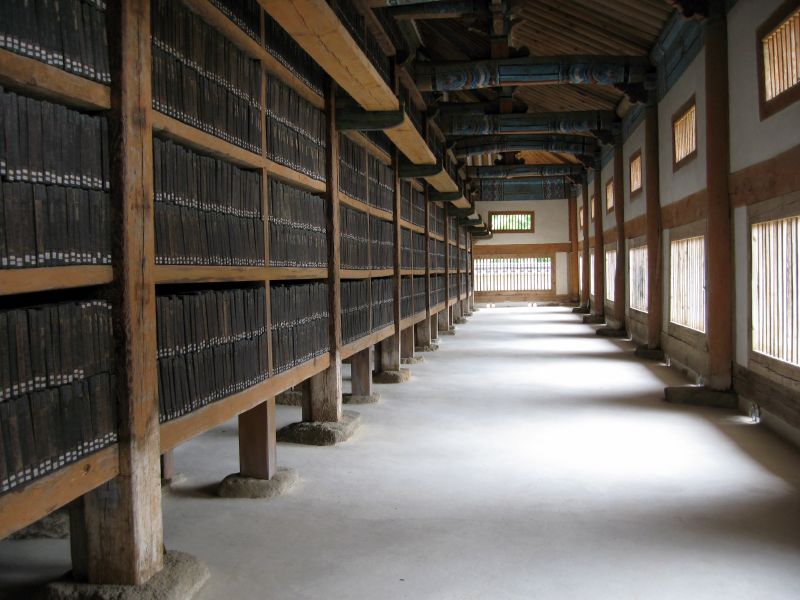
Haeinsa was by far the most crowded temple I've been to yet, and though the architecture was more of the same, Haeinsa is special for a few other reasons. First of all, the scenery is amazing. Like Daewonsa in Jirisan, the buildings are nestled perfectly among the mountains of Gayasan. Second, Haeinsa is home to the Tripitaka Koreana, which are a set of 81,258 wooden blocks from the 13th century containing the Buddhist scriptures in Hanja (Chinese characters). They are only viewable through wooden slats on the outside of the buildings and photography is forbidden, so here's an image courtesy of Wikipedia:
Finally, as this collection of ancient wooden texts attests, Haeinsa is one of the few major temples that survived the Japanese occupation. It has undergone numerous renovations since its construction in 802 AD, and was almost completely burned in the 19th century, but it still holds the place of oldest temple I have seen yet.

After we spent a while at the temple and got involved in a photo-op with an extremely touchy ajumma (that's a middle-aged Korean woman) who was very fond of foreigners, we started up the trail. It quickly became apparent how lucky we were over the Chuseok holiday as far as crowds, because the mountain was absolutely packed. I started to count the number of other hikers I passed, but got depressed and gave up after I reached 200 (and that was before I even reached the summit). Not since Peru have I had to share the heights of the great outdoors with so many people. Here is the seemingly endless line waiting for the summit:
And here is the zoo that is the summit of Sangwangbong itself:
You can see at the very top of the photo another huge line of people waiting to make the twin summit of Chilbulbong. In spite of the endless crowds, we triumphed! And the whole hike was one long stroll through foliage whose like I haven't seen since I left the Adirondacks (it still didn't compare though).

Luke and I came down the opposite side of the mountain, which was luckily a little less crowded, though we still had to pass crowds of other hikers on the narrow trail frequently. All told, it was about 2.5 miles from Haeinsa to the summit of Gayasan, a 2 hour hike at a fast clip. The hike down to Baengundong Village, another 3 miles, took just about 1.5 hours.

Baengundong seemed to be a much more popular destination with tourists than Chi-in, where the bus from Daegu deposited me. There were flocks of taxis and tour buses positively everywhere at the eastern foot of the mountain range. They were all Korean weekender tourists, with the exception of one. Living here, you quickly get used to people approaching you and chattering away in a language that you don't understand one bit, so you learn to ignore it, or at the very least smile and nod. In the main parking lot, a Korean woman approached us, obviously looking to ask us a question or garner help of some sort. A park official stepped in and politely rattled off her spiel in Korean, but the woman was just as perplexed as we were. Turns out she was from Hawaii, and spoke even less Korean than us, so she finally had someone to ask about the hiking trails. It's funny what can throw you for a loop when you judge a book by its cover.

Gayasan is the closest national park to Daegu, so I foresee many more day or overnight visits in the future. However, one thing that is quickly becoming clear is that despite the downfalls of my schedule at EMS, there is something to be said for being able to go camping on Wednesday and Thursday. It's crowded enough in the woods here on a weekday, and the weekends are absolute pandemonium.

Most of my hiking posts seem to be rather verbose, so I'll cap it here for today. I have a lot more to talk about this week though, so stay tuned!


Monday, September 24, 2012

Herb Hillz

This past weekend a few other teachers and I went to Herb Hillz, a nature-themed amusement park in southern Daegu. The park was quite a mish-mash. There was a petting zoo, an eco-adventure obstacle course, carnival games, and some very strange pop culture displays. For instance, here's the scariest Michael Jackson you've ever seen:

Naturally, we were there for the eco-adventure obstacle course. For only $17, we a ziplining harness, a helmet, and a pass onto one of seven obstacle courses up in the trees of our choosing. After signing the waiver, we had to sit through about 20-30 minutes of instruction. Of course, it was all in Korean, so we had to guess at the gist of it based on gestures and common sense. However, most of it was "here's how to use a carabiner," and "don't jump out of the trees," so it wasn't hard to follow. We were briefly tested to make sure we were paying attention (and to see how good our Korean was, perhaps?), and then it was off to the trees:


And here's a video of Matty ziplining to a graceful stop:


We walked through the fragrant herb garden and checked out the petting zoo (some goats had escaped and were running amok through the rest of the park...you know, to the extent that goats can run amok). There was also a small pool with six inflatable hamster balls, each one with a child inside. They were rolling around and knocking into each other. Naturally we wanted to try, but we were told it was kids only. I call that discrimination.

All in all, it felt very similar to a Western amusement park. The musical selection was a touch odd -- I heard, as three songs in a row, PSY's "Gangnam Style" (obviously), Vivaldi, and then a ridiculous instrumental remix of Donna Summer's "Hot Stuff." They may need to work a little bit on their transitions. One refreshing difference was the lack of litigious overtones. Aside from the waiver, there was just a general agreement that your well-being is in your hands, and that no one would be stupid enough to sue for something that they did to themselves.

One more full week of classes, and then it's the five-day Chuseok holiday. Should be a blast. Until next time!

Sunday, September 16, 2012

One Month and Some First Impressions

Since today marks one month here in South Korea, I figured I'd finally get it together and start blogging. This will probably be a long one, but suffer through it and I'll try to make them shorter in the future. And as for the dorky blog name, I gave Phil my word that I would keep it, so stay it shall.

I have been teaching for one month at Avalon English Academy in the city of Daegu, South Korea. Daegu is the fourth largest city in Korea, with a population of 2.4 million. That is a fraction of New York City's population, but it sometimes feels even more crowded here. Here's a photo of my new home from the summit of Yongjibong Mountain, to the south.


And here's the view from the roof of my apartment building. Not too shabby. Also, my building, as demanded by the Asian custom of making everything sound cute, is named "Happy Town."


Since Korea is so mountainous, they've learned how to squeeze millions of people into small valleys. They are also quite good at putting things on top of other things. There are huge netted driving ranges many stories high all over the city. Also check out the standard Korean parking tower. Ingenious.

This is no more than a humdrum parking garage to the locals, but every foreign teacher who comes here is amazed by it. Myself included.

Here is a by no means exhaustive list -- which will hopefully be added to with each post -- of some of the good and the bad I have encountered so far.

The Good
  • Cool inventions. I've had dozens of encounters already with innovative technology or customs where the reaction is always the same: "That's brilliant! Why don't we do that in the U.S.?" We have the parking towers, of course. Restaurants also have very polite, unobtrusive buzzers on every table to get the server's attention. Fast food places often have these numbered discs which they give you when you order, and then you can go about your business elsewhere, and the disc will light up and buzz when your order is ready.
  • The cost of living. Considering my salary here is nearly the same as what I was making in the U.S., and my apartment is free, money goes a long way here. I can get a full dinner at a restaurant (with free refills of all the kimchi and radishes I could want) for about $3.50.
  • The internet speed. Oh wow, that's a cool song, I should downlo...OH WAIT IT'S DONE ALREADY. South Korea has the second highest internet speed in the world, behind only Japan. America is in a very sad 14th place. Americans, you can tell yourselves that's why they're so much better at Starcraft than you, you know, if it helps you sleep at night.
  • The hiking. Being surrounded by mountains is pretty awesome. Yongjibong, in the first picture is only an hour and a half to the top, on foot, from my door. And of course there's an outdoor gym -- free weights and ellipticals and all -- halfway up the mountain. Why? Because Korea, that's why.


The Bad

  • The coffee. I'm not a huge coffee drinker, but I do partake maybe once or twice a week. I am also by no means a coffee snob, but the coffee here is bad. Really bad. Like, monumentally bad
  • The students. Don't let anyone tell you that Asian students are more respectful than their American counterparts. There are many differences, to be sure, but teenagers are teenagers the world over, it would seem.
  • No Pandora. Pandora apparently blocks free access to any IP outside the U.S. Lame!

That's it for now. I promise that my future posts will be more thematic and a less disconnected. I will leave you with PSY's Gangnam Style, which many of you may have already seen since it apparently took off like crazy in the U.S. Here I'm betting it's only another month or two from becoming the official national anthem. I hear it at least six times a day from all sorts of venues. So if you're wondering what living in Korea is like, it's like this. Exactly like this: